
This blog is in reference to “Inventing Black and White, Holocaust and Human Behavior, Chapter 2” where much of its content originates from:
In the 1600s, Anthony Johnson secured his freedom from indentured servitude, acquired land, and became a respected member of his community. Elizabeth Key successfully appealed to Colonial Virginia’s legal system to set her free after she had been wrongfully enslaved. By the 1700s, the laws and customs of Virginia had begun to distinguish black people from white people, making it impossible for most Virginians of African descent to do what Johnson and Key had done.
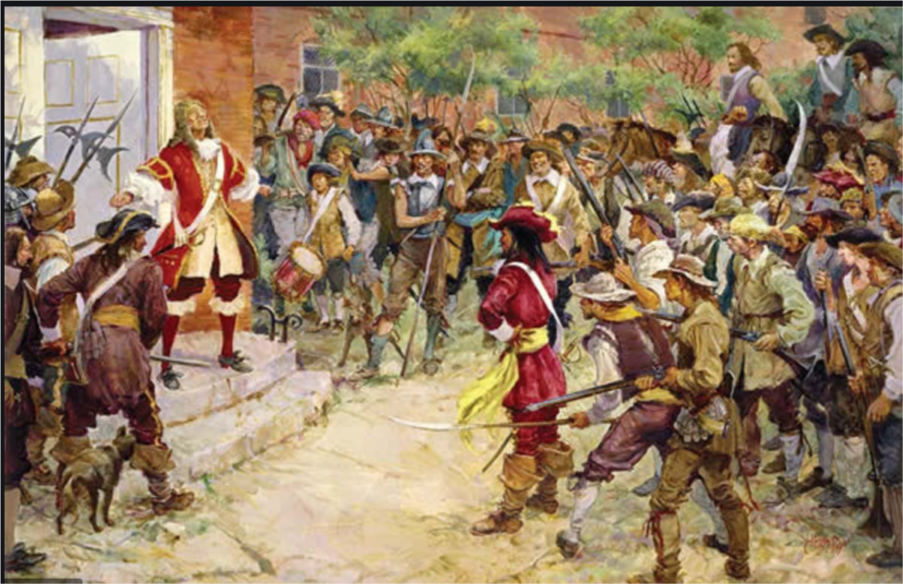
Why did Virginia lawmakers make these changes? Many historians point to an event known as Bacon’s Rebellion in 1676 as a turning point. Nathaniel Bacon was a wealthy white property owner and relative of Virginia’s governor, William Berkeley. But Bacon and Berkeley did not like each other, and they disagreed over issues pertaining to how the colony should be governed, including the colony’s policy toward Native Americans. Bacon wanted the colony to retaliate for raids by Native Americans on frontier settlements and to remove all Native Americans from the colony so landowners like himself could expand their property. Berkeley feared that doing so would unite all of the nearby tribes in a costly and destructive war against the colony. In defiance of the governor, Bacon organized his own militia, consisting of white and black indentured servants and enslaved black people, who joined in exchange for freedom, and attacked nearby tribes. A power struggle ensued with Bacon and his militia on one side and Berkeley, the Virginia House of Burgesses, and the rest of the colony’s elite on the other. Months of conflict followed, including armed skirmishes between militias. In September 1676, Bacon’s militia captured Jamestown and burned it to the ground.
Although Bacon died of fever a month later and the rebellion fell apart, Virginia’s wealthy planters were shaken by the fact that a rebel militia that united white and black servants and slaves had destroyed the colonial capital. Legal scholar Michelle Alexander writes:
The events in Jamestown were alarming to the planter elite, who were deeply fearful of the multiracial alliance of [indentured servants] and slaves. Word of Bacon’s Rebellion spread far and wide, and several more uprisings of a similar type followed. In an effort to protect their superior status and economic position, the planters shifted their strategy for maintaining dominance. They abandoned their heavy reliance on indentured servants in favor of the importation of more black slaves.
After Bacon’s Rebellion, Virginia’s lawmakers began to make legal distinctions between “white” and “black” inhabitants. By permanently enslaving Virginians of African descent and giving poor white indentured servants and farmers some new rights and status, they hoped to separate the two groups and make it less likely that they would unite again in rebellion. Historian Ira Berlin explains:
Soon after Bacon’s Rebellion they increasingly distinguish between people of African descent and people of European descent. They enact laws which say that people of African descent are hereditary slaves. And they increasingly give some power to independent white farmers and land holders . . .
Now what is interesting about this is that we normally say that slavery and freedom are opposite things—that they are diametrically opposed. But what we see here in Virginia in the late 17th century, around Bacon’s Rebellion, is that freedom and slavery are created at the same moment.
According to the Oxford English Dictionary, the first appearance in print of the adjective white in reference to “a white man, a person of a race distinguished by a light complexion” was in 1671. Colonial charters and other official documents written in the 1600s and early 1700s rarely refer to European colonists as white.
As the status of people of African descent in the British colonies was challenged and attacked, and as white indentured servants were given new rights and status, the word white continued to be more widely used in public documents and private papers to describe the European colonists. People of European descent were considered white, and those of African descent were labeled black. Historian Robin D. G. Kelley explains:
Many of the European-descended poor whites began to identify themselves, if not directly with the rich whites, certainly with being white. And here you get the emergence of this idea of a white race as a way to distinguish themselves from those dark-skinned people who they associate with perpetual slavery.
The division in American society between black and white that began in the late 1600s had devastating consequences for African Americans as slavery became an institution that flourished for centuries. Lawyer and civil rights activist Bryan Stevenson explains:
Slavery deprived the enslaved person of any legal rights or autonomy and granted the slave owner complete power over the black men, women, and children legally recognized as property . . .
American slavery was often brutal, barbaric, and violent. In addition to the hardship of forced labor, enslaved people were maimed or killed by slave owners as punishment for working too slowly, visiting a spouse living on another plantation, or even learning to read. Enslaved people were also sexually exploited.

I’m using this historical reference to break the myth of race. That all of us are of the species homo sapiens and that race is a social construct meant to divide humans based on distinguishable features like skin color, hair, eyes and nose. We all have a desire to live in healthy environments, be afforded the means to provide for ourselves and our families and live a life of meaning and recognized value and respect. There are more attributes we have in common as a human family than there are differences.
The wealthy and powerful, the elites have long exploited differences among us for the acquisition and conservation of wealth and power. That it is their interest to keep us divided while they continue to exploit the vast majority of us for our labor, their entertainment and in some cases their perversions. A cursory look at the labor movement historically in the United States and elsewhere demonstrates this. Is it ironic that Martin Luther King Jr. was assassinated in April of 1968 after recently speaking out against the imperial war conducted on Vietnam and organizing a multi-racial, multi-ethnic labor right movement? Being gunned down in Memphis, TN where he was supporting the strike of sanitation workers? The media outlets they control, the political parties and many other institutions prey on our tribal instincts as primates – the need to belong to a group to define ourselves, our identity – and codify those instincts historically in laws to create a caste system where one group feels superior to others.
I’d encourage all of us once we’ve emerged from this global pandemic to venture out. Unplug from social media and cable news, try a ethnic restaurant, maybe if permissible converse and meet with co-workers with different backgrounds and hues outside of the office. Travel – especially if you can afford it, to places outside of the United States – or to a different region of the country. Above all else, read – understand historically why we are where we are – and why people that are different culturally and ethnically have different perspectives. It doesn’t mean we have to agree or conform to someone else’s belief systems or religion. But it does mean we have to learn to live together and break out of our bubbles – for the sake of our survival and that of our children.
 Chronicles in the Black
Leave a comment